.png)


Battles in KwaZulu Natal
Anglo-Zulu War 11 January – 4 July 1879
Battle of Isandlwana | 22 January 1879
Battle of Rorke's Drift | 22-23 January 1879
Battle of Intombi River | 12 March 1879
Battle of Hlobane | 28 March 1879
Battle of Kambula | 29 March 1879
Battle of Gingindlovu | 2 April 1879
Battle of Eshowe Siege | 22 Jan. – 3 April 1879
Battle of Ulundi | 4 July 1879
First Boer War 16 Dec. 1880 – 23 March 1881
Battle of Bronkhorstspruit | 20 December 1880
Battle of Laing's Nek | 28 January 1881
Battle of | 12 February 1881
Battle of Majuba | 27 February 1881
Second Boer War 11 October 1899 – 31 May 1902
Kimberley Siege | 14 Oct 1899 – 15 Feb 1900
Battle of Ladysmith | 30 October 1899
Battle of Colenso | 15 December 1899
Battle of Spion Kop | 23–24 January 1900
Battle of the Tugela Heights | 14–27 Feb 1900
Mafeking Siege | October 1899 to May 1900

The Battle of Isandlwana, fought on 22 January 1879, was the first major engagement of the Anglo–Zulu War and remains one of the most dramatic defeats in British military history. At dawn, British forces encamped beneath the rugged slope of Isandlwana mountain were confronted by a highly disciplined Zulu army employing traditional tactics, speed, and overwhelming numbers. Despite superior firearms, the British were unprepared for the scale and precision of the Zulu attack. By early afternoon, the camp was overrun, and over 1,300 British and colonial troops were killed. The battle shocked the British Empire and highlighted the formidable military skill of the Zulu Kingdom under King Cetshwayo.
Key Dates & Timings
Date of the Battle:
-
22 January 1879
-
Occurred during the opening phase of the Anglo–Zulu War
Approximate Timeline:
-
04:30–05:00 – First sightings of Zulu scouts near the camp
-
08:00–10:30 – Zulu forces (around 20,000 warriors) observed massing in the Ngwebeni Valley
-
11:00 – Zulu regiments begin advancing using the “chest and horns” battle formation
-
12:00–13:00 – Main attack hits the British line; heavy fighting breaks out
-
13:00–14:00 – British defence collapses; the camp is overrun
-
By 15:00 – Battle ends with near-total British losses

The Battle of Rorke’s Drift, fought overnight between 22–23 January 1879, took place just hours after the devastating British defeat at Isandlwana. At a small mission station on the Buffalo River, a force of just over 150 British and colonial troops defended their post against an estimated 3,000–4,000 Zulu warriors. The defenders hastily barricaded the hospital and storehouse with mealie bags and biscuit boxes, holding out through intense waves of assaults. After more than 12 hours of continuous fighting, the Zulu forces withdrew at dawn. Rorke’s Drift became one of the most famous defensive actions in British military history, earning 11 Victoria Crosses and symbolising remarkable resolve against overwhelming odds.
Key Dates & Timings
Date of the Battle:
-
22–23 January 1879
-
Took place immediately after the Battle of Isandlwana
Approximate Timeline:
-
14:00–16:00 (22 Jan) – Survivors from Isandlwana bring news of the defeat; mission station is fortified
-
16:30–17:00 – First Zulu units observed approaching Rorke’s Drift
-
16:45–17:30 – Initial Zulu assaults on the perimeter; heavy fighting begins
-
18:00–20:00 – Repeated attacks against the mealie-bag wall; British fallback to inner defences
-
20:00–24:00 – Intense fighting around the hospital; evacuations made room by room
-
00:00–04:00 (23 Jan) – Sporadic firing and renewed attacks; both sides exhausted
-
04:00–05:00 – Final Zulu probing attacks, followed by withdrawal at sunrise
-
07:00–08:00 – The battlefield falls silent as relief troops arrive
The Zulu Trail
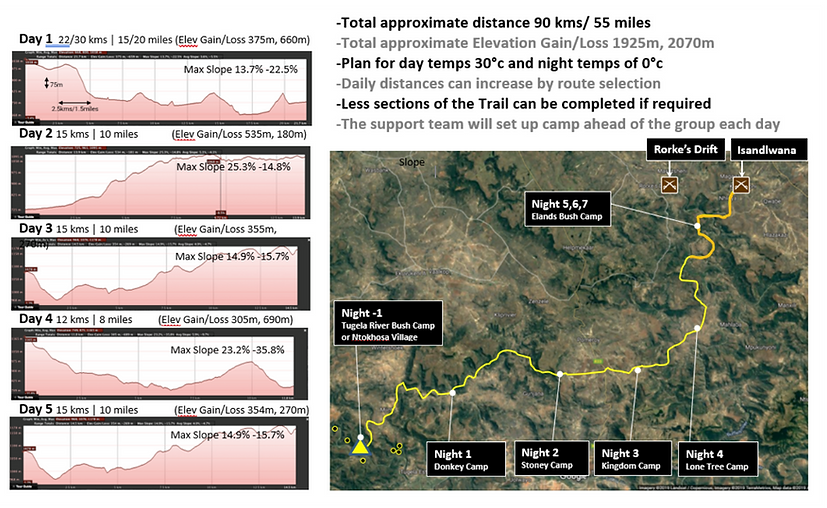
Developed by AWT and our in-country partners, the objective of The Zulu Trail Expedition is to trek 100kms over 5 days in KwaZulu Natal, from the Zulu iron smelting sites on the banks of the Tugela River, through stunning country, to the Anglo-Zulu War battlefield of Isandlwana.
We believe this is an ancient route from the old Zulu iron smelting sites on the Zulu capitol of Ulundi. Half way to Ulundi is Isandlwana and Rorke's Drift, our trek destination.
We will also walk the famous 'Fugitives Trail' from Isandlwana battlefield to the Buffalo River, following the route British soldiers took that fateful day in 1879.
KwaZulu Natal
Battlefield Sites
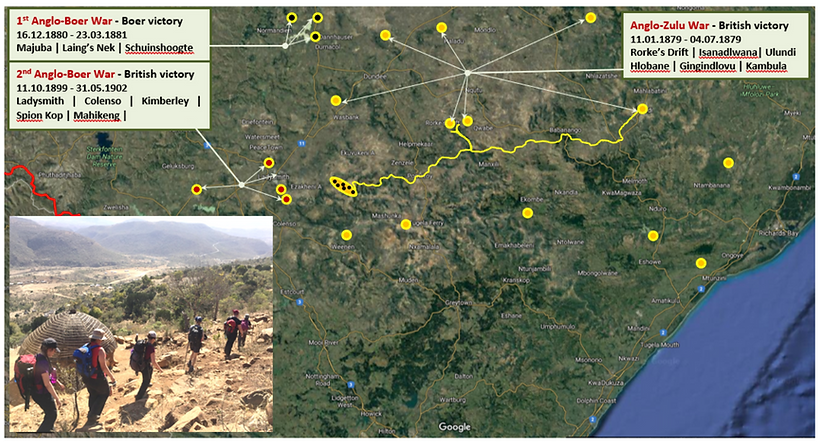
KwaZulu Natal is peppered with battlefield sites from the Anglo-Zulu & Boer Wars.
AWT as put together various itineraries for your group to experience the locations, as well as the opportunity to walk in the footsteps of British, Boer, and Zulu soldiers.
You will visit the memorial locations from both sides of the wars, and hear the stories brought to life by our exceptional historians.
.png)